
Dangl, Jeff
HHMI Investigator and John N. Couch Professor
dangl@email.unc.edu
4260 Genome Sciences Building
(919) 962-4469 (office)
At a Glance
- How do plants recognize pathogens?
- How do intracellular innate immune receptors of the NLR family function?
- How is the plant associated microbiome condition plant growth and environmental response?
- And how do these commensal microbes navigate or evade the plant immune system?
Synopsis
Many interactions between plants and microbes begin with specific recognition. The nature of this recognition, and the interpretation of subsequent signal transduction by both plant and microbe have profound impact on the outcome of the interaction. Plants have evolved effective mechanisms to recognize pathogenic microbes and halt their biotrophic or necrotrophic growth in the plant. Active plant defense mechanisms obviously force the selection of microbe variants which can evade the plant’s recognition capabilities. This evolutionary tug of war has led to a complex set of both plant and microbe genes, whose interactions lead to a successful plant resistance reaction. As well as a potentially large array of cognitive gene functions, a number of subsequent signal transduction steps must be necessary to generate a completely effective resistant phenotype. Plant-microbe interactions can also benefit the plant and plant’s select a small and taxonomically constrained set of microbes from the very rich microbiome of the soil. These commensals help the plant access minerals and can protect against pathogens. We study both the molecular mechanisms of the plant immune system and the intricacies of how that immune system sculpts the well organized and functional root microbiome. Our ultimate aim is to use knowledge, genetics and microbes from nature to enhance plant performance and soil sustainability across the globe by defining fundamental rules of microbiome assembly and function.
My lab has studied the genetics of plant-pathogen interactions since 1989. Our two main interests are the control of pathogen recognition by plants via their two tiered immune system consisting of extracellular pattern recognition receptors and intracellular nucleotide-binding, leucine-rich repeat (NLR) receptors, and the formation and function of the root microbiome. In the immune system, we study NLR activation and its outcomes, activation of transcriptional re-programming to result in pathogen growth restriction and, ultimately, hypersensitive cell death. We also study the structure, function and evolutionary genomics of bacterial pathogen type III effectors and oomycete effectors. These pathogen proteins suppress host defense by manipulating host protein machinery. We are dedicated to mapping that set of host machines using the evolved tools of the pathogen to identify them. We study these interactions at the molecular and structural level. In the root microbiome, we are defining the community structure of plant rhizoplane and endophytic microbiomes and trying to define design rules for small bacterial consortia that will enhance plant health and productivity. This project relies on genomics, ecological modeling, metabolic modeling and both forward and reverse genetics. We have expertise and momentum in these research arenas and we collaborate widely to extend our technical and intellectual reach. My lab is a diverse set of individuals from several countries who each bring different expertise to their projects, and to the other projects in the group. We stress small team approaches to the problems introduced above. My students and post-docs thus have access to a variety of inputs about their work. We work on biological scales from nanometers to small mesocosms. Our lab alumnae have been successful in job placement in a variety of careers.
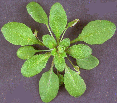
We use the reference model plant species, Arabidopsis thaliana, in our research.